
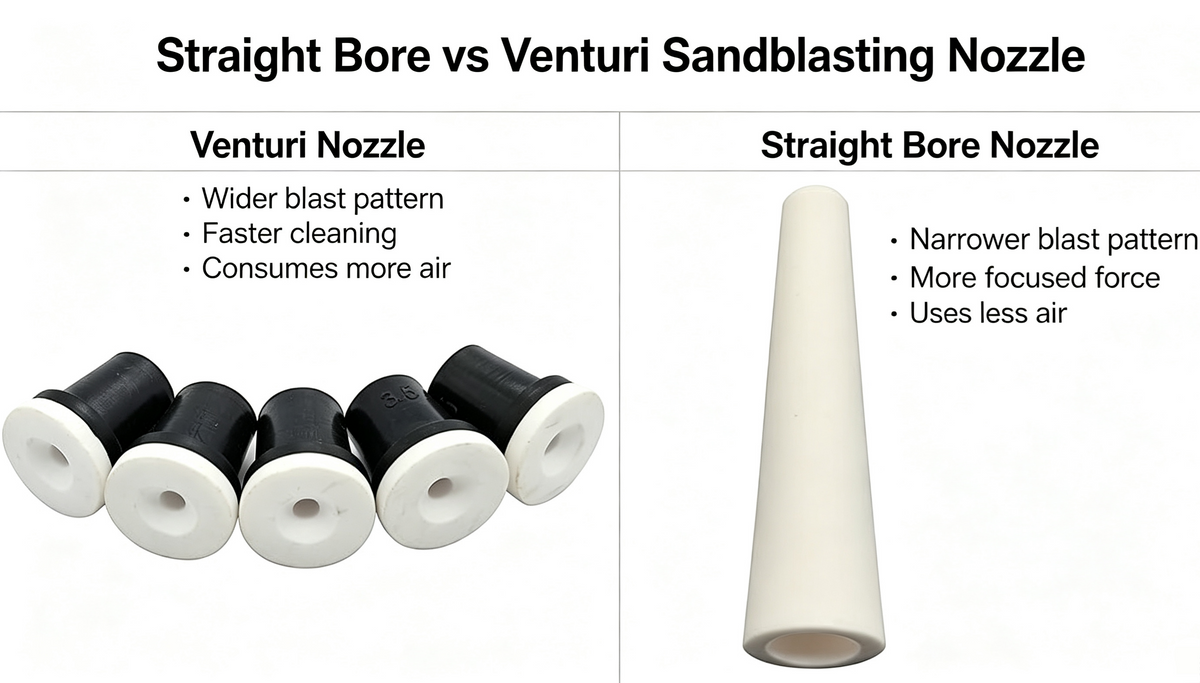
Choosing the right sandblasting nozzle can directly affect cleaning speed, abrasive consumption, and surface quality. The two most common nozzle designs are straight bore nozzles and venturi (diffusion) nozzles.
So, what is the difference between them?
Straight Bore Nozzle: Strong Impact & Precise Control
A straight bore nozzle has a simple internal design with the same diameter from inlet to outlet. It creates a concentrated blast stream with strong impact force.
Advantages:
- High blasting pressure at the target area
- Excellent control for detailed work
- Lower cost and easy to use
Best For:
- Small parts cleaning
- Spot blasting
- Sandblasting cabinets
- Rust and paint removal on small areas
However, the narrow blast pattern means it covers less surface area, making it slower for large projects.
Venturi Nozzle: Wider Coverage & Higher Efficiency
A venturi nozzle uses an expanding internal design to improve airflow and abrasive acceleration. The result is a wider blast pattern and better cleaning efficiency.
Advantages:
- Larger blasting coverage
- Faster surface cleaning
- Better abrasive and air efficiency
Compared with straight bore nozzles, venturi nozzles can improve productivity by around 30%–50% in many industrial applications.
Best For:
- Large metal surfaces
- Industrial blasting
- Ship, automotive, and construction applications
Quick Comparison
| Feature | Straight Bore | Venturi |
|---|---|---|
| Blast Coverage | Narrow | Wide |
| Cleaning Speed | Medium | Faster |
| Precision | Excellent | Good |
| Efficiency | Standard | Higher |
| Best Use | Small jobs | Large surfaces |
Which Nozzle Should You Choose?
Choose a straight bore nozzle if you need precise control for small areas.
Choose a venturi nozzle if you want faster cleaning, wider coverage, and better efficiency for professional blasting work.
For most industrial sandblasting applications, a high-quality venturi nozzle is the better choice for improving productivity and reducing operating costs.


Leave a comment
This site is protected by hCaptcha and the hCaptcha Privacy Policy and Terms of Service apply.